
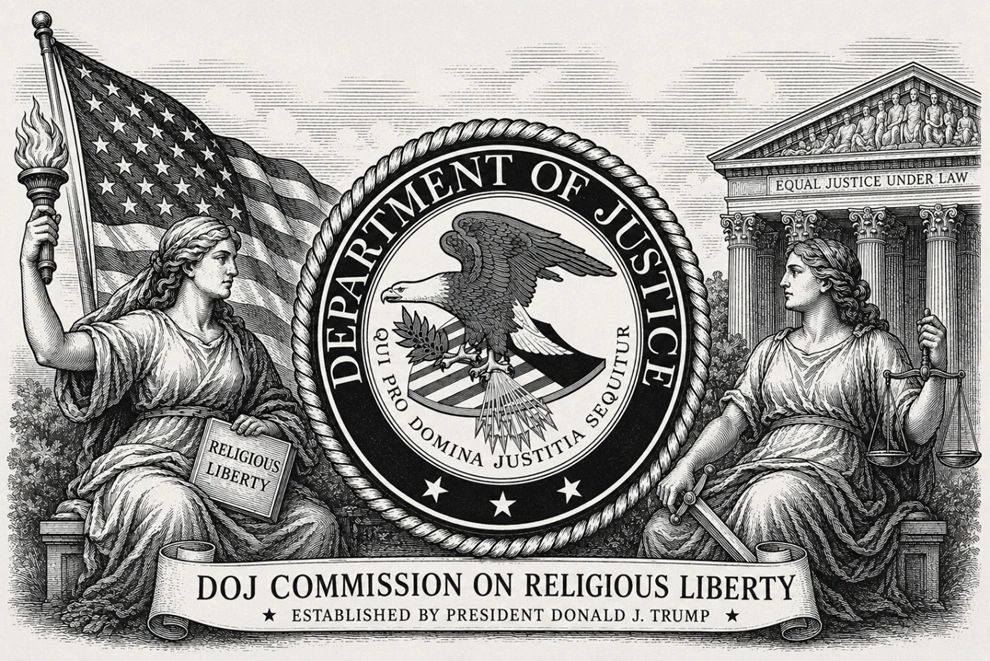
On April 13, 2026, the Religious Liberty Commission established by the administration of President Donald J. Trump concluded that there is no true or absolute separation between church and state. In response to this conclusion, faithful Seventh-day Adventist Christians have written letters expressing respectful, yet firm opposition, grounding their position in Scripture, constitutional principles, and the testimony of history itself.
At the heart of the issue lies a question as old as civilization: who has authority over the conscience of man? The Bible answers plainly. Christ declared, "Render therefore unto Caesar the things which are Caesar's; and unto God the things that are God's" (Matthew 22:21). In these words, two distinct realms are identified. Civil government is entrusted with maintaining public order, administering justice, collecting taxes, and governing relations among individuals. God alone, however, holds authority over worship, conscience, and the loyalty of the soul.
No human government has the right to compel belief, regulate worship, or enforce religious observance. Any attempt by the state to enter this sacred domain becomes an overreach of authority. True faith cannot exist without freedom, for the gospel calls rather than compels. God invites, persuades, and appeals to humanity, but He never forces obedience. Genuine worship must arise voluntarily from conviction and love. The moment worship is compelled by law or civil pressure, it ceases to be true worship.
This principle is reflected in Revelation 14, where humanity is called to "fear God and give glory to Him." This is an appeal to conscience and willing allegiance, not fear imposed by civil authority. God seeks willing hearts, not enforced conformity. Worship directed toward the Creator cannot be mediated or compelled by either church or state. If the state dictates worship, the very foundation of religion is violated.
These biblical principles harmonize completely with the First Amendment to the Constitution of the United States, which declares that "Congress shall make no law respecting an establishment of religion, or prohibiting the free exercise thereof." Such protections exist because civil authority is not competent to govern the conscience.
The history of the United States itself confirms the necessity of this principle. Many early settlers fled systems where church and state were united and religion was enforced by law. Their experiences revealed that even well-intentioned religious legislation eventually leads to coercion. For this reason, the founders established a system designed to protect both religion and government by keeping them distinct. Thomas Jefferson described this protection as a "wall of separation between Church and State," while Abraham Lincoln upheld the principle that conscience must remain free from coercion.
If a law requires the observance of a religious practice or something that could be construed as religious, it ceases to be merely civil and becomes religious in nature. It is tantamount to establishing religion.
While the authority of government is derived from the consent of the governed in civil matters, religious matters can never be subject to majority rule. No majority, however large, possesses the right to dictate the religious beliefs or practices of even one individual. Truth and duty toward God are not determined by vote.
History repeatedly confirms this lesson. In Europe, centuries of alliance between church and state led to persecution and the suppression of conscience. The abuse of religious authority intertwined with civil power contributed to the reactionary violence of the French Revolution. When religion is enforced by the state, faith itself becomes corrupted, and society often responds with instability and hostility toward religion.
The principle endorsed by the founding fathers of America was that faith must remain free. The Declaration of Independence affirmed that all people are endowed by their Creator with certain unalienable rights, among which is liberty. This understanding shaped the constitutional commitment that government must neither establish religion nor interfere with its free exercise.
From the teachings of Christ to the lessons of history, the conclusion remains consistent: whenever church and state unite, liberty of conscience is endangered. But where they remain distinct, both religious freedom and civil peace are preserved.
For this reason, the principles of religious liberty, free exercise of faith, and separation of church and state must be upheld. Religious liberty is an inherent right grounded in humanity's moral responsibility before God. Scripture declares, "So then every one of us shall give account of himself to God" (Romans 14:12). Because accountability is personal before God, liberty of conscience must remain inviolable (too sacred to harm) before the state. Joshua's appeal still stands: "Choose you this day whom ye will serve" (Joshua 24:15). Allegiance to God must be freely chosen, never compelled.
Benjamin Franklin observed that a religion requiring civil authority for support reveals its own weakness. Scripture affirms the same truth: "Not by might, nor by power, but by my spirit, saith the Lord" (Zechariah 4:6). William Penn wisely stated that force may produce hypocrites, but never true converts.
Thomas Jefferson regarded separation as a safeguard for both civil liberty and religious purity, while John F. Kennedy affirmed that liberty of conscience can only survive where government remains free from religious control and religion remains free from government interference.
Any union of church and state inevitably leads toward corruption of religion and infringement upon conscience. Scripture itself provides the clearest example in the trial and crucifixion of Christ. Religious leaders lacked the legal authority to execute Him and therefore appealed to the Roman governor Pontius Pilate to carry out the sentence. Though Pilate found no fault in Christ, he yielded to religious pressure and authorized the crucifixion. Thus Christ was condemned through the combined action of church and state. This tragic union demonstrates that when religious authority employs civil power to enforce its will, and the civil power embraces the dictates of religion, the result is not righteousness, but injustice and suppression of truth.
Christ Himself declared, "My kingdom is not of this world" (John 18:36). Civil power cannot advance Christ's kingdom. Any attempt to do so stands contrary to His own words.
The principle remains clear: the state must govern civil matters such as law, justice, and public order, while religion must remain free and accountable only to God. Any blending of these spheres, however small, threatens both liberty and genuine faith.
As Scripture declares, "It is better to trust in the Lord than to put confidence in man" (Psalm 118:8). Guided by this principle, faithful Christians continue to affirm their unwavering commitment to liberty of conscience and their respectful but firm opposition to any union of church and state.
I. Isaac
Comment Policy
Just a short read, click here to read