
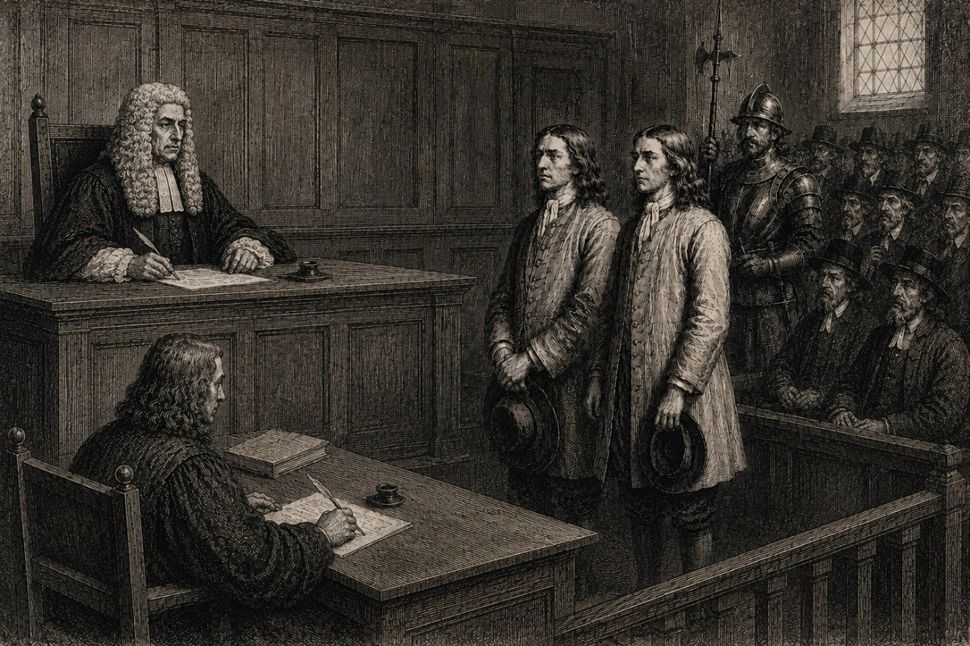
"Ye are Englishmen, mind your privilege, give not away your right." These words were shouted in court by twenty six year old William Penn to the jury that would decide his case. To Penn the jury responded, "Nor shall we ever do it!"
It was September 3, 1670 - the third day of the trial of two Quakers, William Penn and William Mead, at the Old Bailey in London. They were accused of violating the Conventicle Act, a law forbidding religious gatherings of more than five people outside the organized framework of the state sponsored Church of England. Penn and Mead dared to preach to a crowd of people on a London street. The two men were arrested and imprisoned.
During their trial the judge, wanting to secure a conviction, pressured the jury to reach a guilty verdict. But the jury, led by foreman Edward Bushel, was not having it. They returned a verdict of Not Guilty. The judge was furious! He rejected the verdict of the jury and threw them all in jail without food, water, or heat for two days. In addition he also threatened them with fines and further prison time if they did not bring in a verdict of Guilty. Penn shouted the words quoted at the beginning of this article as the jury was being led out of the courtroom to jail.
But the judge underestimated the resolve of Bushel and the rest of the jurors. Though confined under these harsh conditions for two days, when summoned, they returned their final verdict - Not Guilty. The judge promptly fined the jurors, held them in contempt of court, and put them back in prison until the fines were paid. But Edward Bushel had not had his last word. He challenged the legality of these proceedings. It was at this time that Chief Justice Sir John Vaughan of the Court of Common Pleas declared that jurors must be allowed to operate independently of the government - even the court itself - and cannot be penalized on account of their decisions.
This affirmation of the independence of the jury underscores the indispensable role that citizens play in jurisprudence. Trial by a jury of peers went on to become a vital part of the legal system of the United States of America. This principle serves as a check on both legislative and judicial power. The fact is that Penn and Mead did violate the law; but the people believed that the law was an abuse of authority, and they voiced their protest through their refusal to convict the two men.
If ever such checks and balances were needed in a society, they are needed at the present time. However, in the very nation of William Penn, things seem to be headed in the opposite direction. BBC News reported (March 10, 2026) that proposed legislation to do away with trial by jury advanced to the next stage in the British Parliament despite the open opposition of thousands of legal professionals. If the measure is passed into law, cases in which the defendant is facing three years or less in prison would be decided by a single judge, rather than a jury of peers. "That would mean no juries in most cases of theft, fraud, burglary, handling stolen goods, money laundering, 'ABHs' (assaults occasioning actual bodily harm), domestic violence, harassment, stalking, drug possession with intent to supply, as well as many sexual offenses and GBHs (grievous bodily harm)." (Matthew Scott, Removing Jury Trials is a Democratic Outrage, Spectator Australia, 26 November 2025)
What would George Orwell say to this? Or better yet, would William Penn not shout again - "Ye are Englishmen, mind your privilege, give not away your right."
Many mistakenly believe that trial by jury has its origin in English common law - beginning with the Magna Carta in 1215. Others point back to the Greco-Roman practice of using large panels of citizens to hear cases. But the true origin of trial by a jury of peers predates these uses. The Old Testament establishes this concept in the Law of Moses in which judges (plural) are chosen from among the people. Prior to the visit of his father in law, Moses had been presiding solo over the judicial process. But the wise Jethro admonished him with these words - "the thing that you do is not good." Exodus 18:17. In the verses that follow men were chosen from among the people who were capable, honest, and unselfish. Exodus 18:21 These men were commissioned to act as judges for the people. It is clear that these men heard cases in groups, rather than singly. Later chapters mention cases being brought before "the judges." Exodus 21:6,22; 22:8,9; Deuteronomy 19:17,18. Deuteronomy 1:17 invites the people to consider that the judgment process which they had been taught to follow was "God's" - meaning that God was its Originator.
This biblical evidence suggests that trial by jury is not a mere human invention. On the contrary, it is an outgrowth of the principles of the Great Controversy between Christ and Satan, in which God allows angels, and even human beings to review the evidence for themselves in order to certify that He has been fair and just both in process and in the final decisions (1 Corinthians 6:3). The heavenly origin of this judicial process explains its relative rarity throughout history. Its brief moment of flourish among western democratic nations is owing almost exclusively to the influence of Protestantism and its emphasis on the Bible. The subsequent, sad surrender of true Protestant principles has paved the way for a departure from sound judicial process.
The effort to eliminate trial by jury in the UK is another prime example of how the intoxicating wine of Babylon (Revelation 14:8 and 18:3) is making the inhabitants of the earth drunk. We often think of this wine as false religious doctrine only. It includes this, of course. But we must remember that Babylon is not merely a religious power. It is simultaneously an oppressive civil power. This civil power is just as intoxicating as is the false religious teaching that accompanies it. We often speak of people who are "drunk with power," don't we? So it is no wonder that as the influence of Protestantism wanes, there is a simultaneous move away from trial by jury towards a more inquisitorial judicial process. We can imagine many in our political class salivating at the thought. Now is the time for the people to say, like the noble Edward Bushel and his colleagues - "Nor shall we ever do it!"
S. Dobson
Comment Policy
Just a short read, click here to read