
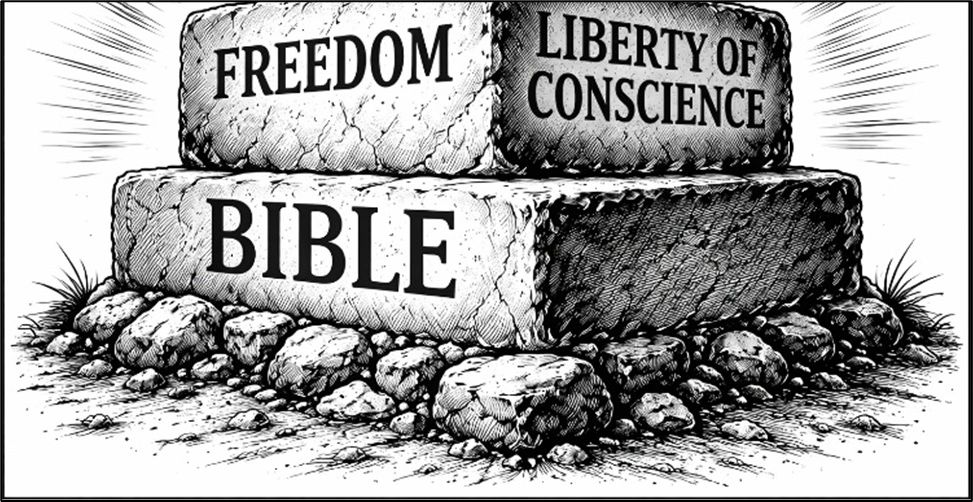
Where does human freedom, and our concept of it, come from? Is it the result of chance, the blind byproduct of unguided social and historical forces? Or is it an "unalienable right" bestowed by a higher power, as the writers of the American Declaration of Independence suggest? The Bible states that "God created the heaven and the earth" (Genesis 1:1), and profound implications about human freedom emerge from the Bible's creation account.
Freedom is a Moral Issue
If we exist merely as a result of random materialistic processes, then the concept of freedom likewise arose by chance. This would mean that while we may personally value the principle of freedom, no absolute moral imperative exists for society to defend and protect freedom. However, the Bible says humanity was created for a specific reason—to have "dominion" over the rest of creation—that is, to be free. "And God said, Let us make man in our image, after our likeness: and let them have dominion over the fish of the sea, and over the fowl of the air, and over the cattle, and over all the earth"¦" (Genesis 1:26). Because God created humanity to be free, freedom becomes a morally imperative issue.
Freedom Disappears Without God
The Bible's second verse reveals the condition of the world immediately before God began the work of creation: "And the earth was without form, and void; and darkness was upon the face of the deep. And the Spirit of God moved upon the face of the waters" (Genesis 1:2). Without God's presence and influence, the world becomes a chaotic wasteland. What was true physically before creation also applies morally and socially when God and the Bible are removed from society.
The French Revolution, which began in 1789, promised equality, liberty, and fraternity for all. However, a new calendar was eventually introduced that annulled Christian holidays, and church property was confiscated. On November 10, 1793, portions of the Bible were burned at a "Festival of Liberty and Reason," and days later, all churches were closed. The Reign of Terror followed, and thousands of people were executed, often with no trial. As the blood flowed, freedom died too.
Interwar Germany in the 1930s is another example of what happens when God is removed from society. A recent study found that Nazi influence was strongest in those parts of the country where Christianity was the weakest:
""¦the lower the share of Christian first names, the more frequent superstitious practices in interwar Germany—and the higher the number of Nazi voters and party members. Importantly, we also find predictive power at the individual level: Within each municipality, the likelihood of joining the Nazi Party was higher for those with less Christian first names—and the higher a party member's rank, the lower the proportion of Christian first names."1
Concentration camps, mass graves, and crematoriums resulted from this political system, and millions of innocent people died.
Freedom is Established on Law
God's physical creation of the universe set in operation numerous physical laws. These so-called constants of physics—there are nearly thirty of them by some counts—are very finely tuned. Tweak most of them by even a fraction of a percentage and life as we know it would not be possible. The point? Physical life depends on law, as does freedom. Remove the rule of just laws in a society, and anarchy and despotism will come sooner or later. As Ronald Reagan once said, "Law and freedom must be indivisible partners. For without law, there can be no freedom, only chaos and disorder; and without freedom, law is but a cynical veneer for injustice and oppression."2
Freedom is Build on Division
Evolutionary theory suggests that life arose through chance and the random combining of atoms, molecules, and cells. However, the Bible describes God's physical creation of earth as a work of division. On each day of creation week, God accomplished a work of division:
Day 1. God DIVIDED light from darkness.
Day 2. God DIVIDED the waters above and below.
Day 3. God DIVIDED plants by their kind.
Day 4. God DIVIDED the day and the night.
Day 5. God DIVIDED birds and fish by their kind.
Day 6. God DIVIDED land animals by their kind.
Day 7. God DIVIDED time and created the Sabbath.
This principle of division extends beyond God's physical creation of the world. Freedom within human society also depends on the division or separation of powers.
The framers of the Constitution of American and many other nations have understood this principle, and created governments with three separate branches—legislative, executive, and judicial. In theory, at least, this division of powers acts as a system of "checks and balances" and prevents any single branch of government from assuming too much power. Thomas Jefferson, who helped write the American constitution, was clear about the importance of this principle. He wrote, "The principle of the Constitution is that of a separation of legislative, Executive and Judiciary functions, except in cases specified. If this principle be not expressed in direct terms, it is clearly the spirit of the Constitution, and it ought to be so commented and acted on by every friend of free government."3
The separation of church and state is another fundamental principle of freedom. The First Amendment of the U.S. constitution stipulates, "Congress shall make no law respecting an establishment of religion, or prohibiting the free exercise thereof"¦" The separation of civil and religious power in the United States has protected liberty of conscience and personal freedom for over 200 years. Tear down this wall by allowing the state to govern the church—or the church to govern the state—and freedom of conscience will eventually disappear.
T. Rumsey
________
1http://www.jvoth.com/shallow.pdf
2Ronald Reagan, Proclamation 5175, Law Day U.S.A., 1984
3Thomas Jefferson, From Thomas Jefferson to James Madison, 22 January 1797
Comment Policy
Just a short read, click here to read