
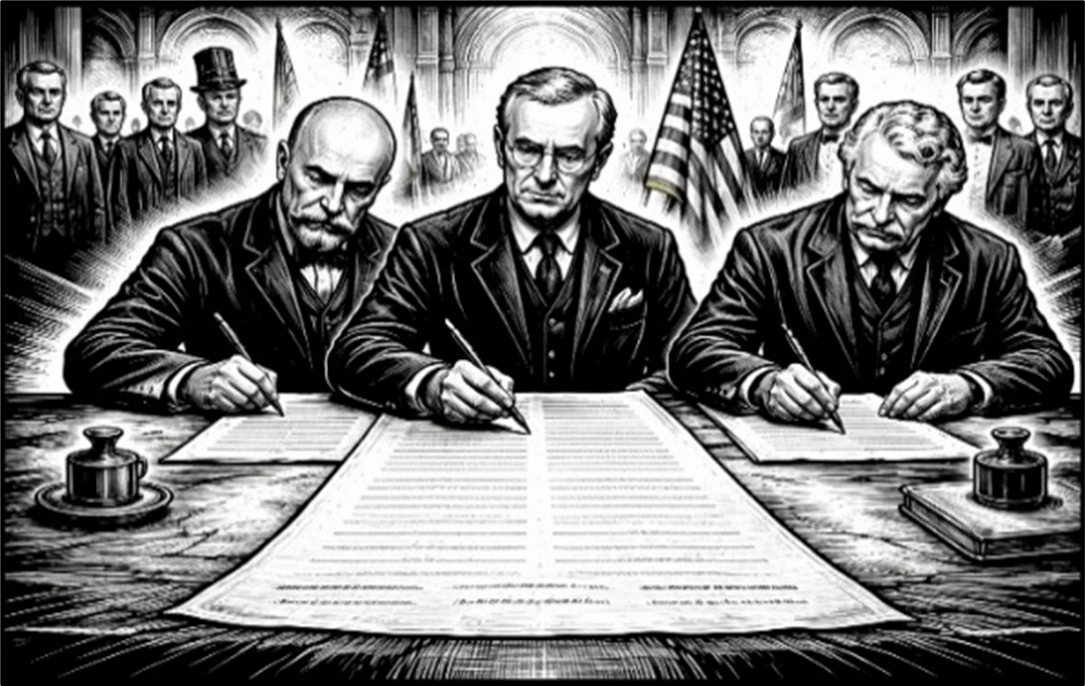
In 1919, the Treaty of Versailles ended the state of war between the 'allied nations' (England, United States, and other allied powers) and Germany. The Treaty led to the formation of the League of Nations. Part XIII of the Treaty introduced international Labor Conventions. In Volume XIII, Section II, Article 427.50, it says that all members states should abide by, "The adoption of a weekly rest of at least twenty-four hours, which should include Sunday wherever practicable."1
The introduction of Section II, Article 427, says,
"The High Contracting Parties, recognising that the well-being, physical, moral and intellectual, of industrial wage-earners is of supreme international importance, have framed, in order to further this great end, the permanent machinery provided for in Section I and associated with that of the League of Nations" (emphasis supplied).2
By 1921, the League of Nations had established the International Labor Office, and was seeking to implement a weekly rest convention (Convention 14). Whilst Sunday was not explicitly identified as the day of weekly rest, it was intended to be a uniform day of rest established by religious customs and traditions.3
When the League of Nations was replaced by the UN, the International Labor Office, with Convention 14, were adopted. They extended the scope of the Weekly Rest Convention to include additional industries in Convention 106 in 1956.4 In the 1920s, when the first weekly rest conventions were implemented, devout Seventh-day Adventists, who kept the seventh-day Sabbath, were prosecuted. They were no longer able to operate their business on Sunday, after being closed on Saturdays, without penalties.5
In 1961, an American Sabbath-keeping Jewish shop owner and their staff were convicted and fined for selling items that were not permitted to be sold on a Sunday. While this was not an issue of weekly rest, it was about setting Sunday aside as distinctly different from the remainder of the week. The shop owners argued that as seventh-day Sabbath keepers, they should be free to sell any items on Sunday that they needed to as they were not open on Saturday. They stated that the statute that prevented them from selling items on Sunday went against their constitutional rights in relation to the free expression of religion. However, the "State Supreme Court [determined] that the present purpose and effect of the statute here involved is not to aid religion, but to set aside a day of rest and recreation."6 The implication was that Sunday trading laws were a civil and not a religious matter.
In other countries, such as Australia, Sunday laws have been in place since before the 1920s and have continued to be in place.7 These manifest in terms of restrictions on trade, types of employment, and penalty rates (higher wages) imposed on employers who have staff working on Sunday.8
Are rest days truly a civil matter? Is it necessary to have a universal day of weekly rest in order to achieve and maintain the civil order of society?
The human body cannot sustain work seven days a week, twenty-four hours a day. These limitations need to be recognized by labor laws. However, this does not necessitate that a specific rest day be prescribed throughout society through labor laws.
It is clear that legislated rest days around the world are established by the religious customs of the majority in a nation. This is why, throughout most of the world, the day typically designated as a day of rest is Sunday – the day set aside for worship by many Christians.
The first day of the week, Sunday, has never been written into the law of God as outlined in the Bible. Yet, this is not the only reason why a legislated universal rest days is wrong.
As noted in the introduction to the Treaty of Versailles, rest days have implications for individuals' moral well-being. Morality is a matter of the conscience and thus a spiritual matter, not a matter of the state. Therefore, it for the individual to decide to work or rest on any particular day.
The weekend has become the accepted norm, and Sunday is the accepted rest day, whether or not a person is religious. The awareness of its historical basis in enforced Christianity has largely been forgotten.9 If a religion other than Christianity were to suddenly predominate in Western society that imposed Friday as a universal day of rest, such rest laws would no doubt be protested against for their role in enforcing religious ideologies. Universal rest days should never be legislated for and should never be seen as a civil matter.
J. de Bruyn
_______
1 Papers Relating to the Foreign Relations of the United States, The Paris Peace Conference, 1919, Volume XIII, U.S. Department of State (Washington, D.C.: Government Printing Office, 1947), Section II: General principles (Article 427), accessed December 11, 2025, https://history.state.gov/historicaldocuments/frus1919Parisv13/ch22subch2.
2 Ibid.
3 International Labor Organization (ILO), "Convention No. 14 (Weekly Rest in Industrial Undertakings, 1921)," November 17, 1921, accessed October 8, 2025, https://normlex.ilo.org/dyn/nrmlx_en/f?p=NORMLEXPUB:12100:0::NO:12100:P12100_INSTRUMENT_ID:312159:NO.
4 International Labour Organization (ILO), "Convention No. 106: (Weekly Rest (Commerce and Offices), 1957), Geneva: International Labour Office, June 26, 1957, accessed October 8, 2025, https://normlex.ilo.org/dyn/nrmlx_en/f?p=NORMLEXPUB:12100:0::NO:12100:P12100_INSTRUMENT_ID:312251:NO.
5 A. W. Anderson, "Universal Enforcement of Sunday Laws Proposed: A Call to Prayer," Australian Record 30, no. 20 (May 17, 1926), 1–2, accessed December 15, 2025, https://documents.adventistarchives.org/Periodicals/AAR/AAR19260517-V30-20.pdf.
6 United States Supreme Court. McGowan v. Maryland, 366 U.S. 420 (1961), accessed October 12, 2025, https://supreme.justia.com/cases/federal/us/366/420.
7International Labour Office, Report VII on the Weekly Rest-Day in Industrial and Commercial Employment, Third Session, International Labour Conference, Geneva, October 1921 (Lausanne, Switzerland: Imprimeries Réunies S.A. for the International Labour Office, 1921), 7–9, accessed December 11, 2025, https://webapps.ilo.org/public/libdoc/ilo/1921/21B09_17_engl.pdf
8 Rozner, G. & Lane, A. Penalising Work – A Historical Account of Penalty Rates in Australia, Accessed March 30, 2026
https://ipa.org.au/research/penalising-work-historical-account-penalty-rates-australia.
9 Law Reform Committee of South Australia, Ninety-Second Report: Inherited Imperial Sunday Observance or Lord's Day Acts (Adelaide: Government Printer, 1987), accessed December 12, page 2, 2025, https://law.adelaide.edu.au/system/files/2019-02/92-Inherited-Imperial-Sunday-Observance-or-Lords-Day-Acts.pdf
Comment Policy
Just a short read, click here to read